




July 24, 2026
by Katya Poltorak, Northeastern University
edited by Swati Mestri, reviewed by Andrew Zinin
Scientific Editor
Chief Editor
This article has been reviewed according to Science X's editorial process and policies. Editors have highlighted the following attributes while ensuring the content's credibility:
fact-checked
trusted source
proofread
Add as preferred source
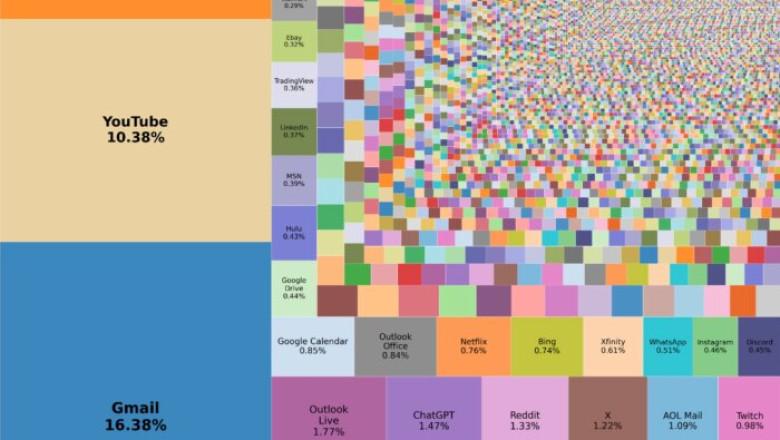
 Each rectangle represents one of the 344,753 unique websites viewed between June 2024 and December 2025. The size is proportional to its share of total user time. Credit: David Lazer.
Time to check if you've got mail. Again.
What keeps people glued to the computer screen? Turns out it's not Netflix marathons, Reddit rabbit holes or impulse Amazon splurges—it's Gmail.
A research team at Northeastern University's Institute for Information, the Internet and Democracy found that this platform captures by far the largest share of users' collective attention and accounts for a whopping 16.38% of all desktop browsing time.
No amount of streaming, doom-scrolling or impulse shopping compares to the simple act of checking your inbox, according to the May 2026 study. The data used in the research came from the National Internet Observatory, a research organization that had consenting participants install browser extensions to track their internet use.
"I'd like to think that was just me. I spent a lot of time on email," said study author David Lazer, a Northeastern University professor of computer science and political studies.
But he's certainly not alone. As the paper puts it, "the average person in (the) sample spent more time on Gmail alone than on the bottom 300,000 websites combined," referring to the 344,653 sites included in the report. A total of 4,608 users took part in the study.
The pattern did vary quite a bit across generations. The study found that people over 65 spent over a third of their time on Gmail, while their younger counterparts devoted only 11.6% of their time to their inbox. Still, email is a daily staple for everyone as "the tool of choice for work-related stuff and basic communication," Lazer explained.
"And Gmail is the big kahuna," he said.
In fact, the slice of desktop time devoted to inboxes might be even larger, Lazer added, explaining that the study didn't capture data from Outlook or other standalone desktop apps. A follow-up study on mobile browsing, due in the next few weeks, will fill in the gaps by tracking app usage.
After Gmail, YouTube accounted for 10.38% of total desktop browsing time, while Facebook made up 7.97%. Once again, there are some age-related differences, with older users spending about 14% of their time on Facebook and younger ones only about 2%. Older users also accounted for most of the use of additional email platforms, such as Yahoo Mail and Outlook, which also appeared among the top websites.
Other social media sites, such as Reddit and X, made up the second-largest category. Productivity tools, including Google Docs and Google Search, came next, with commerce, streaming, search, large language models (LLMs), gaming and news ranking just below. For better or worse, news now ranks below ChatGPT.
Although Google Search ranks in the top 10, it might seem surprising that it falls below Gmail. After all, according to the statistics platform Statista, "finding information" ranks as the main goal that internet users around the world report for going online.
It comes down to how often you open a certain site versus how long you linger there, Lazer explained. You might use Google a lot, "but you don't necessarily dwell on (it). You do a search, and then you move on," he said, adding that with email, "hours disappear."
The researchers found that the top 10 platforms capture nearly half the total time. It's amazing "how much of our online experiences are mediated by a very tiny number of platforms and companies," Lazer said.
Activist Thorin Klosowski from the Electronic Frontier Foundation isn't surprised by the research results. "The major tech companies have worked really hard to be all-in-one landing spots for the internet as a whole, so people don't even think about what alternatives might exist," he said.
Just think about it: You don't "Vivaldi" (another web browser) or even "Firefox" a hint to a crossword puzzle or the schedule of a local bus. You Google it.
This concentration of content into big platforms also makes it unlikely that the data, which the researchers gathered from June 2024–December 2025, would look very different today. Lazer explained that platforms that are already big tend to attract more users, stay big and grow over time. "You get bigger by being big," he said.
Co-author Burak Ozturan raised a delicate point that some have brought up after the release of the study. What about the adult sites? Surely NSFW (not safe for work) browsing can't be close to nonexistent, as the results seem to suggest.
Ozturan put this matter to rest by explaining that users were free to go off the radar and switch to private mode when they wished. It skews the results a bit, but "that's part of doing this ethically," Lazer explained.
Ozturan, who is leading the mobile study, said preliminary results show that, although basic trends look similar to those in desktop browsing, some notable differences are emerging.
"Email turns out to be big on phones too ... and of course TikTok is vastly bigger on mobile," Lazer said. Social media apps, such as Instagram, will likely loom large. Shopping apps will have a big presence as well, followed by productivity and business ones.
However, the biggest winner in the mobile world is turning out to be messaging. "People are sending messages to each other via either WhatsApp or Facebook Messenger. It's the biggest category so far in our measurement," Ozturan said.
This trend, in turn, echoes Gmail's reign over desktop browsing. With messaging in the lead instead of email, "the biggest use is still communication," Lazer said.
The fact that communication still commands the most attention is good news for those concerned about the way the digital environment is shaping the people engaging with it.
Poet and filmmaker Max Stossel, who also serves as the head of education at The Center for Humane Technology, said he's "happy to see it's taking up more of our desktop time than social media." Given that "the vast majority of content watched on YouTube (and Facebook) is algorithmically driven," people end up "being pushed ideologically toward the most extreme, outrageous ... versions of the world." He found it refreshing that the internet's potentially toxic traps don't dominate browser use—though they're not too far behind.
In the end, if you're going to spend a few hours online, answering emails and getting in touch with friends is a pretty harmless way to do it.
David Lazer et al, How Americans Spend Their Time Online, (2026). DOI: 10.2139/ssrn.6991638
Provided by
Northeastern University
Who's behind this story?
 Swati Mestri
Swati Mestri holds a bachelor's degree in Electronics Engineering and has worked as a content editor since 2019. She has experience editing research documents across technology, health care, and materials science, and has a particular interest in technology and space. Full profile →
Master's in physics with research experience. Long-time science news enthusiast. Plays key role in Science X's editorial success. Full profile →
This story is republished courtesy of Northeastern Global News news.northeastern.edu.
Aug 5, 2026
0
Aug 5, 2026
0
Aug 6, 2026
0
Aug 5, 2026
0
Aug 6, 2026
0
5 hours ago
Aug 7, 2026
Aug 7, 2026
Aug 7, 2026
Aug 7, 2026
Aug 7, 2026
Aug 6, 2026
Aug 6, 2026
Aug 6, 2026
Aug 6, 2026
Feb 9, 2023
May 8, 2024
Sep 17, 2024
Mar 5, 2026
Jun 15, 2026
May 14, 2024
5 hours ago
Aug 7, 2026
Aug 7, 2026
Aug 7, 2026
Aug 7, 2026
Aug 7, 2026











Comments
0 comment